We're Becoming Reverse Centaurs
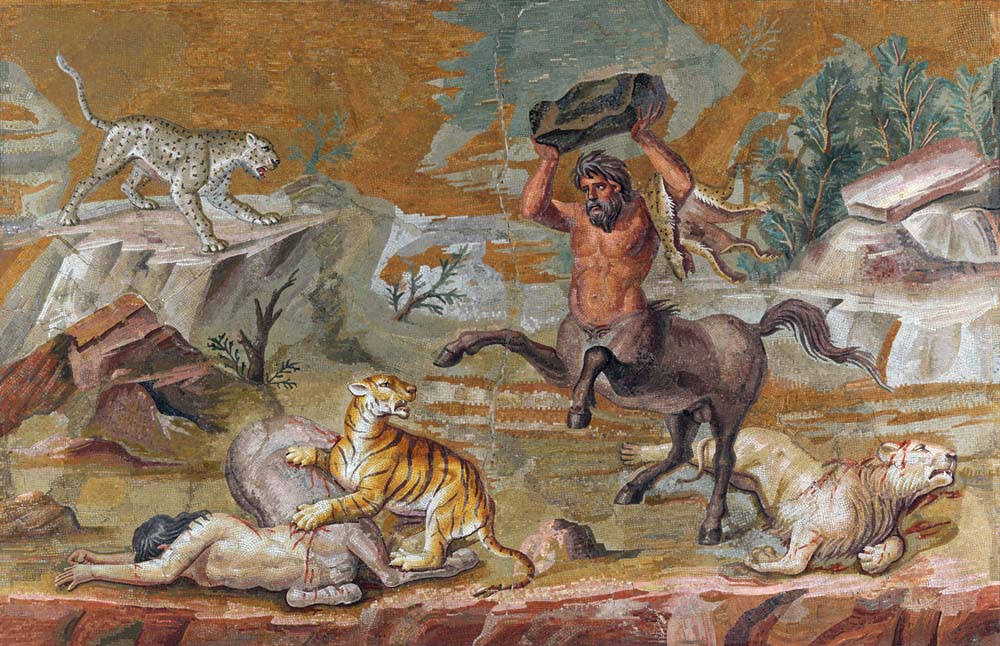
In Greek mythology, the centaur (a man-horse) is a recurring and well-known character. It symbolized the tension between humanity's developed civilization and its primal and instinctive nature. The upper body including the brain* represents human-only qualities such as reason, thought, and logic.
The lower body represents the strength, toughness, and endurance that animals must possess to thrive in their world.
* Early Greeks of the Homeric period did not fully understand the brain's role in human reason, thought, feeling, and logic. Later on, during the classical shift, Greek physicians such as Hippocrates, asserted qualities to the brain that better align with modern views.
This further solidifies the symbiosis of the half man, half horse nature of the centaur. That is, a creature with human intelligence, reason, and feeling but with animal strength, toughness, and endurance.
What's that got to do with tech?
Glad you asked!
The Modern Centaur
Cory Doctorow, author of Enshittification and many other books, tech pundit, advocate for digital civil rights, and a cool guy to boot, has reimagined the centaur in modern terms. It's still the same metaphor, just modernized. Today's modern centaur is a person who performs at higher levels by understanding and using modern tools.
The symbiosis is clear, just as it was with the ancient Greek centaur: The human person provides the brains and the tech provides the brawn.
If you're of a certain age, you might remember the popular 1970's TV show The Six Million Dollar Man. The protagonist, a test pilot that is grievously injured in a crash, undergoes reconstructive surgery and receives "bionic" implants that gives him super human capabilities. That is more than just a metaphorical centaur. Or perhaps a cyborg, using more modern terms.
One of the key indicators of humanity is the ability to make and use tools. In this context, a tool is any object that can assist in performing a job.
There are (at least) four overall classes of tools:
- Manual: Using a hand saw or axe to cut down a tree.
- Manual+Assist: Using a motorized chainsaw to cut down a tree.
- Preprogrammed automation: Pressing a button to activate an articulated chainsaw that cuts down a tree.
- Autonomous: Articulated chainsaw moves about on its own, selects the trees to harvest, then cuts them down, all without human supervision or intervention.
The earliest tools were completely manual and had no moving parts: Using a rock to crack open nuts, throwing a spear to slay prey, or using a pencil to write a letter. The tool helped focus the effort to complete the task in a way that just using your hands could not, but provided no additional strength (usually) or endurance. All the energy needed to complete the task came from the user of the tool.
Then came manual+assist tools. These tools must still be operated by a user in much the same way that a manual tool is, but now the tool contains its own energy and additional mechanisms to perform the actual work. The human must be skilled at using the tool, to guide the tool. But the tool does the real work.
In the case of a chainsaw, for example, a logger can fell a tree in a tiny fraction of the time that a manual saw or axe would take. But the logger must still skillfully operate the chainsaw using motions and positioning that approximate a manual saw.
The third class, automation, removes the human from the real work altogether. The human is there to direct, observe, and maintain the automated tool. The tool may be operated by a wired or wireless remote control console meaning the operator isn't in direct contact with the tool. We see industrial automation everywhere: Canning and bottling plants, automobile assembly, grain harvesting, coal mining, warehouse logistics (like Amazon), and many more.
The fourth class, autonomy, is a self-directed tool, which can recognize when a task needs to be performed, initiate the task, see it to completion on its own, without human intervention. And all the while taking measures to resolve unexpected problems that may arise while performing the task. In other words, doing everything that a human might be called upon to do -- but without the human.
The Workaday Office
One of the more notable early office productivity improvements came when we switched from exclusively using a manual tool, like a pencil, to using a typewriter. The typewriter is a mechanical device that (after it was perfected) allowed the operator to standardized letters and create forms that were easy to read.
Similarly, the mechanical adding machine allowed the rapid and simple computation of numbers with far greater speed and accuracy than doing it by hand.
Other examples include the telephone, photocopier, and fax machine.
And so it went over the years. New machines were developed but they were still fundamentally assisting an otherwise manual task -- not really changing the nature of the task to be completed. Work became faster, more accurate, more reliable, easier to do, and less expensive. Office productivity grew significantly.
These workers were centaurs.
All these tools had (at least) one thing in common: They facilitated the completion of tasks that already existed as manual tasks. These early machines (tools) did not by dint of their existence create additional, different tasks that, too, needed performing.
But then an interesting thing happened.
As productivity grew, managers started seeing a void of sorts developing. Specific tasks assigned to an employee that previously required, say, eight hours (one working day) to complete, were now being completed in, say, four to six hours. That void was the worker either not being busy or working more slowly to fill out the day. That presented both a problem and an opportunity.
Those productivity gains meant the managers could reduce staffing until the remaining employees were once again busy all eight hours. But depending on the particulars of the company and their needs, it also meant those same employees could do additional or different work that heretofore wasn't possible or even necessarily needed.
Maybe that additional work was profitable. But not always. And, I'd argue, not even usually.
Dog eat Dog
In the world of organizational hierarchy, each level is accountable to the level above them and dependent on the level below them. Middle management is a particularly dicey place to be in most organizations. One the one hand, they have powerful bosses above them (directors and VPs) to please. And on the other hand, they have employees below them doing the real work and reporting to them -- employees whose performance and productivity butters the middle manager's bread.
Fairly or not, the arc of middle management is sometimes seen as redundant.
You might ask, what the hell are middle managers good for then beyond being a translation layer between the higher-up bosses and the lower workers?
That's not an unfair question.
Managers, like anyone else, are sometimes irrational beings, driven by risks and incentives, imagined or otherwise. Only the guy at the top (of the company) truly calls the shots. Everyone else, all the way down to the toilet attendant, each has to report to someone.
This is why a CEO like Jeff Bezos is ultimately why Amazon delivery drivers are peeing in bottles because they don't have time to find a proper restroom. No, Bezos did not personally mandate no potty breaks. But his ruthless pursuit of efficiency (apparently) without regard to any negative externalities helped make piss bottles a thing. Bezos could have established a culture where piss bottles would not have come about as a solution to a problem. But he didn't.
So these managers are constantly looking for an edge, an angle, trying to outdo other peer managers as a way to garner accolades from above, to please their bosses, to hopefully being next in line for promotion. And this is where things can go in a number of directions.
One of those directions for managers is making sure their employees are "busy". And busy can be many things. Common busywork includes writing status reports of various types, establishing KPIs (Key Performance Indicators) and monitoring who meets them, annual performance reviews, and meeting after meeting after meeting. Good Lord, all those meetings...
And a great way to make that happen is software. As computers have become cheap enough for every office worker to have one, the software has become more and more intrusive and time consuming, meeting the mandates of the managers who are competing to please their bosses.
Where once we were centaurs, leveraging technology to help humans work smarter and faster, we've now become reverse centaurs, serving the machines and software that we're mandated to use.
Fritz Lang's seminal 1927 film Metropolis explores this theme of man and machine, of work, what it means, and our place in it. IMDb Link
This is the point where the Solow Paradox is realized. Famous pull quote: "You can see the computer age everywhere but in the productivity statistics"
From Education to Administration
Colleges, universities, and K12 schools have been around for a long, long time. Even as recently as the mid 20th century, at the toddler stage of office productivity tools, these institutions' core mission hasn't change much.
In the days of purely manual processes or with a mechanical assist, like the adding machine example above, it was simply not possible to have the kind of metric tracking and record keeping that we see today. Yet they managed to execute their core mission, educating students, just fine.
Any full time faculty today will attest to how difficult their job has become since the introduction of LMSs (Learning Management Systems) and all the bureaucratic crap that facilitated. My wife, a Professor of Mathematics, spends nearly as much time on the administrative aspects surrounding her classes as she does on the classes themselves. LMSs consume a significant amount of time for no real benefit to anyone except managers (administrators) and the makers of expensive LMSs.
And that's already accounting for the explosive growth in the administrative ranks, especially in colleges and universities. What the heck are all those people doing?
But it's not limited to collages and universities.
Since the around the time that computerization started making inroads into organizational life in academics, business, and governments, the level of tracking, reporting, detailed information storage, retrieval, and analysis increased. Because computerization made all this possible then countless organizations insisted that full use of those new capabilities be made.
There are numerous "laws" and studies that support this view. I've linked to the Wikipedia article for all these.
Gall's Law: "A complex system that works is invariably found to have evolved from a simple system that worked. A complex system designed from scratch never works and cannot be patched up to make it work. You have to start over with a working simple system. Gall also wrote "Systems tend to grow, and as they grow they tend to encroach."
Parkinson's Law: "Work expands so as to fill the time available for its completion."
David Graeber argued in his book The Utopia of Rules that computers did not eliminate bureaucracy as promised. Instead, they allowed organizations to create and sustain vastly more rules, forms, approvals, and compliance processes because the administrative overhead became affordable.
A different but related take is Conway's Law: "Organizations which design systems are constrained to produce designs which are copies of the communication structures of these organizations." That basically means that complex organizations create complex software, which in turn often reinforces organizational complexity.
As a consequence of all this increasing complexity, the actual per-capita worker productivity has levelled off and started slumping in the 2000s. And I attribute a good deal of that to the rise of cloud-based*, all-encompassing, enterprise management software that promises to "do it all".
* Simply being cloud-based isn't the only problem. But being cloud-based means the vendor has far more control over the customer relationship. That vendor's #1 priority is self-preservation and growth.
These enterprise management systems can be insanely complicated to learn, fully understand, and use. See my article on the four E's for more on this phenomenon. Employee onboarding takes longer and data entry mistakes can carry greater, farther-reaching consequences*.
* Terry Gilliam's 1985 dystopian sci-fi Brazil illustrates nicely how crushing bureaucracy goes awry.
Then there's the whole new major topic of concern: Software bugs, security vulnerabilities, and social engineering for criminal gain have led to sensitive data breaches and downtime costing businesses, governments, universities, and private individuals untold tens of billions of dollars in damage and countless lost hours of productivity since the beginning of the 21st century.
These breaches, a major concern to organizations of all kinds today, didn't even meaningfully exist until around the year 2000 give or take.
Just sit and contemplate that for a few minutes, I'll wait...
An entire category of crime that has so far cost society many tens of billions of dollars came about because of the degree of (sloppy, mostly cloud-based) computerization over the last 25 years or so. How can anyone believe we're in a better place now? It's shocking.
AI has entered the room
And here is where the third class of tool, automation, comes for the knowledge worker.
Today, nowhere has the potential subservience to a system been greater than it is to AI. AI has infiltrated the modern workplace both architecturally and in individual workers hands. It pervades like nothing else before it -- the digital equivalent of kudzu.
There's a lot of debate about whether AI is, or will, take jobs away from humans and to what extent. I see that as inevitable, but that's for another article.
Regardless, AI has needs. AI is prone to producing errors, what are generously called "hallucinations". I've written elsewhere that discuss why AI is so error prone so I'm not going to explore that here. See my article All About AI for more details.
Because AI is error prone, then it needs humans to detect and correct them. AI researchers are slowly improving error rates but due to AI's current probabilistic architecture, it'll never be error-free.
Employees who are required to work with AI are the foot soldiers so to speak of this monitoring and corrective effort. When the AI they're working with makes a mistake, it's up to that employee to recognize and fix it. Specific corrections are generally topical, one-off fixes. Depending on implementation, systemic errors can be gathered, analyzed, and corrections fed back into the training model. But, again, due to AI's probabilistic nature, that's no guarantee of success.
This worker/AI relationship, where the worker finds and corrects the AI agent, can and will span occupations where that relationship exists.
In this context / example, this is when the worker becomes a reverse centaur. AI is no longer assisting the employee. AI is the primary worker now and the employee becomes the tool that is charged with assisting the AI.
The not-so-subrosa goal, as promised by the AI Big Tech companies, is reducing payroll expenses by reducing headcount.
But another thing that employee becomes is an accountability sink. Since we all know that AI can make mistakes, then the employee charged with using the AI is responsible for catching and either correcting the error or notifying the appropriate team of that error. If the error slips by, the employee is to blame, not the AI.
Monitoring AI, or anything else, may seem pretty simple. But it's not.
In automation theory, the "safety monitors" suffer in ways that weren't well understood before monitored automation became a thing.
Self Driving Cars
Take the example of safety monitors being in the driver's seat of a fully autonomous test car. They're suppose to take corrective control of the car if/when the self-driving system makes a mistake. That's a job doomed to fail from the get-go.
Driving a car requires active engagement, mental processing, and a continuous flow of instinctive quick decision making. Never mind that a lot of people already have trouble just doing that.
Now put that person into a position of being a passive safety observer of a self-driving car. The car is making all the decisions while the human just watches. The human is outside the workflow, out of the loop. There is no chain of intuitive or cognitive decisions in the human's brain. When the car makes a mistake, especially a stupidly obvious mistake that few humans would likely ever make, then the human sitting there must immediately shift from passive observer to not only the active driver, but one that must evade an imminent collision.
The human doesn't have to be distracted by something else, either. Even if the human is paying attention, what I said just above is still true! Passively observing even while paying attention is very different from being an active participant.
That is a very tall order. And that's why the entire idea of a safety driver is disingenuous.
Software Development
Other areas where employees are becoming reverse centaurs to AI is in computer programming. AI agents can spit out code at fantastic rates, writing thousands of lines of code or more per day. But that code is likely to contain a lot of subtle errors.
In computer programming, there are, broadly speaking, syntax errors and logical errors.
Syntax errors are easier. The development environment displays warnings right on the screen.
But logical errors are much harder to find. Maybe you meant to add two numbers together but instead you multiplied them. Or program a statement to do x only if y is true, but instead you wrote it to do the opposite. These kinds of errors don't usually display a warning. But depending on where in the code they are and what the code is designed to do, these errors may appear quickly or may not appear for a long time.
Those are just easy to describe logical errors that may involve only a single statement. There are other, more difficult to find logic errors, than may involve hundreds of lines of code.
Human programmers make logical errors all the time. That's what unit testing is designed to catch. Unit testing can be difficult, unpleasant work -- like trying to find a needle in a haystack.
Now imagine that AI is spitting out all the code. That leaves the human programmers to do less programming (the fun, stimulating part) and doing more unit and integration testing (the boring and more difficult part).
And, worse, since the human did not author the code, then parsing the code for obscure, low-visibility logical errors can be even harder. Just like the safety driver, the human programmer is out of the cognitive workflow.
AI is sometimes used to scan for errors as well. It can and does find them. But, again, since AI is prone to making its own errors, they still must be verified by humans.
In all this, human programmers become the reverse centaur and an accountability sink. That really sucks for a programmer.
Finally and perhaps most tragically, ceding code creation to AI will diminish human programmer's skill in original problem solving. Future programmers will certainly lack the creative chops and deep understanding that current programmers possess. AI-authored systems will be an abstract black box of code that fewer human programmers will understand.
Closing
There's not really anything in the way of advice in this article. It's just me describing my observations of what I see as the decline in productivity that all these computers, datacenters, and software were supposed to improve.
There's a real possibility that if AI is truly successful, that it becomes part of the office landscape, then the so-called knowledge workforce will plateau and shrink. I can't be sure of that, of course. My crystal ball is no better than yours.
But what, exactly, is the point of AI in the workplace if not to ultimately displace workers? We did just fine before AI came long. So what problem is AI supposed to solve?
Learning a skilled, hands-on trade may be the best hedge a younger person has today.