Intellectual Property
We're a society today where intellectual property (IP) protections in its various forms are a huge and constant feature of the digital landscape.
In this article, we'll discuss the broad topic of Intellectual Property, what it means, how it affects everyone one of us in unexpected and insidious ways, and how it's frequently abused for monied interests.
I leave it to you to further research any areas that particularly interest you.
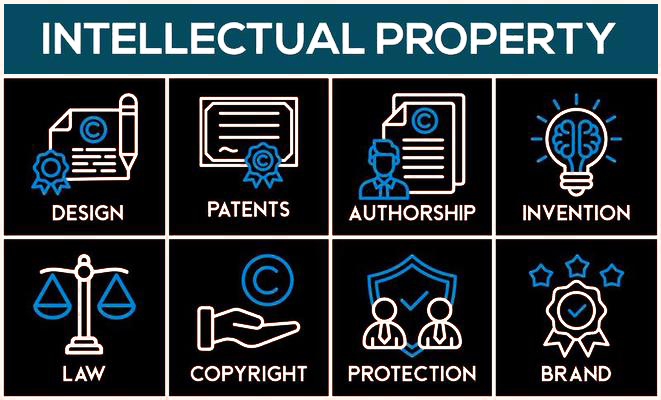
Various realms of intellectual property
What does Intellectual Property mean?
The term Intellectual Property is nothing new -- it was first used in the 18th century. It simply means things that are born of the human mind. This can be physically tangible, like a better mouse trap, or an idea, like a poem. But the term, sometimes abbreviated as IP*, came into common parlance (outside of legal and legislative circles) since probably the 2000s or so.
That aligns to when copyright matters became a much bigger issue due to new digital capabilities and online distribution methods -- and the ease with which copyright "violations" could occur.
I scare-quoted "violations" because not all violations are equal, as we'll discuss below.
* IP, being only two letters, can stand for many other things including Internet Protocol, Ingress Protection (a water resistance rating), Investment Property, and lots more. Context defines the initialism.
I. Copyright
This is one the bigger subtopics under IP that affects most people, if only in subtle ways. It's certainly one of the most controversial topics and one that is likely violated the most.
Copyright is a complex subject, but here's a 30 second elevator description: Copyright laws protect creative works against unauthorized uses for a specified length of time. During this time, the creators control how that content may be used including the money to be earned. In general, when the copyright expires on a protected work, it enters the "public domain" which means anyone is free to use it in any way they see fit.
On the surface, copyright seems like a reasonable thing. Creators of music, movies, books, poems, paintings and drawings, photographs, TV shows, and other things birthed from the human mind, and distributed for the enjoyment of others, deserve to be paid for their works. Most of us would agree with that.
But there's a lot of ways that strict adherence and enforcement of those ideas to the nth degree can cause problems.
Music is Derivative
Very nearly -- if not all -- music is derivative to some extent. Hell, all creative arts are derivative, to some extent. The muse that inspires an artist was itself inspired, even if oh so slightly, by what came before. This is a basic, foundational tenet of the creative process.
Yet music copyright law has a really hard time with that. Here's just two examples of the hundreds of lawsuits on this very topic.
Led Zeppelin
Take for example the universally recognized (well, among boomers, anyway) opening guitar riff in Led Zeppelin's Stairway to Heaven. Another rock band, Spirit, sued Led Zeppelin for copyright infringement, saying that Jimmy Page (Led Zeppelin's lead guitarist), had plagiarized that riff. After a lengthy battle Led Zeppelin eventually prevailed and again on appeal. Had they lost on appeal, it could have cost them tens of millions of dollars.
Men at Work
Another case was a lawsuit filed against the 1980's Australian rock band Men at Work. The rights holder of a 1932 Australian children's nursery rhyme and it's accompanying tune called "Kookaburra (sits in the old gum tree)" sued Men at Work for copyright infringement, accusing them of plagiarizing the song in the opening tune and beat (using the flute) in their hit song Down Under -- a well-known and beloved song considered an unofficial Australian national anthem.
The lawsuit lasted for years, causing Men at Work great pain, heartache, and money. They stood to lose many millions in back royalties if they lost. Well, they did lose that suit. But, thankfully, the presiding judge granted a fairly minor award of 5% of earnings and only after a certain date. When later calculated, it amounted to a reported $100,000. Much less than it could have been.
But fighting that suit cost Men at Work millions and it was particularly hard on Greg Ham, the flutist who played the riff in question. Ham passed away a short time later with friends and family saying the lawsuit weighed heavily on him. Such a tragic story.
The rights holder, Larrikin Music, who sued, had no connection to the author of the children's nursery rhyme/song other than having had the good luck of buying the rights many decades later and after the author's death, for a pittance. The lawsuit against Men at Work was a sleazy, naked money grab, pure and simple.
You can Google these cases for yourself.
There are many other examples of music copyright run amok.
It's one thing to copy and rerecord an entire song, soup to nuts, or to otherwise profit from it at the expense of the former producer. Copyright law, correctly, helps fix that.
It's quite another thing altogether to write a song that may mimic a few notes or a brief riff from a previous work. Nearly every song written borrows something from earlier works. That might be a particular chord progression, key change, timing signature, lyrical clichés, and numerous other elemental components of a song. Simply having heard songs in one's past indicates and influences future song writing. There's no way a song could be 100% unique. That is impossible.
Copyright is supposed to protect and foster creativity. But due to abuses, like those above, it can actually stymie creative expression. Everyone loses. Artists, the public, even the record companies -- everyone.
I can well imagine the day that unethical parties will feed songs by the millions into AI music recognition engines looking for other examples of potential infringement, all in effort to score an undeserved award.
That needs to stop.
The Immortal Mouse
Large, deep-pocketed content producers would love for their works to never enter the public domain. To that end, they regularly lobby congress for copyright extensions -- and receive them. While they haven't gotten perpetual protections just yet, they have managed to get multiple favorable overhauls over the years.
▶︎ The Copyright Act of 1790 (the first), provided 14 years of protection with an option for a one-time 14 year renewal if the author was still alive, giving a maximum 28 years.
▶︎ In 1831, the initial term was expanded to 28 years with the same 14 year renewal option for a total of 42 years of protection.
▶︎ The 1909 Copyright Act extended the renewal to 28 years, for a total of 56 years of protection.
▶︎ The 1976 Copyright Act changed things up considerably. Now the protections were for the life of the author plus 50 years, for individual works. For corporate works for hire (like Disney), the term became 75 years from publication.
▶︎ In 1998 copyright protections were changed again -- informally known as the "Mickey Mouse Protection Act" because it was heavily lobbied for by Disney whose copyrights on the earliest Mickey Mouse cartoons were due to expire. This extended the protections to life of the author plus 70 years. Corporate for-hire works received 95 years from publication.
These lengthy extensions, coupled with the litigious nature of alleged copyright infringement and plagiarism, have stymied the creative process -- not fostering it, as industry insiders would have you naively believe.
Woe be to any artist who inadvertently creates something that has the faintest whiff of an earlier work. These lawsuits are costly to defend, let alone any crazy awards that may result.
II. DRM
DRM, or Digital Rights Management, is a legal and technology framework that controls (limits) how you are permitted to consume content and use the products that you own. Any use outside of these narrowly defined acceptable terms is unauthorized and may be considered piracy -- that is, lawless behavior.
And this is exactly how the movie studios and record companies want you to think about piracy -- in terms of simple right and wrong, with zero nuance.
But there's enough nuance here for a Woody Allen movie, as we'll discuss below.
There's plenty of fair uses which is not, or shouldn't be, illegal. For example:
- Making a backup disc (or on a hard drive) of your content in case the original were to be damaged or goes bad due to manufacturing defects. That happens; optical discs don't last forever. e.g. Numerous Warner Brothers discs from 2006 to 2009 are prematurely rotting away (oxidizing) internally, making them unplayable.
- Maybe you want to store your disc collection on a media server so you can watch what you want without having to search a bookshelf, disc storage binders, or dig through boxes, etc. looking for the disc.
- Format rot. This is where certain physical media becomes obsolete. e.g. 8-track tapes, laser disks, and eventually DVD and Bluray. Would be nice if you could copy content from older formats to newer formats.
- Load up some movies on a tablet or laptop, neither of which have optical readers these days, for a long road trip for your kids or for a long international flight.
But because of DRM, you can't do any of that. Oh sure, some newer movies may come with a digital copy that you can download. But that's only for fairly recent releases -- no dice for older movies or any TV shows. That digital marketplace never did fully develop or work smoothly. And even when it does work, it has a lot of strings attached that can prevent you from watching the movie on your terms.
DRM can also be used to prevent you from watching a disc or streaming content from an unlicensed country. Many people have learned the hard way that a disc they brought with them or their streaming subscriptions don't work if they take a trip abroad even though they are subscribed to the US instance of their streaming provider. This is called region locking. You can't watch that movie or TV show because your carcass happens to be in Italy right now. It's stupid, inconvenient, and serves no discernable good purpose.
All this DRM shit just contributes to a poor consumer experience.
Hoisting the Jolly Roger
Studio and industry groups claim that piracy results in billions of dollars of lost revenue per year and that DRM measures are necessary to help prevent that. There's a wee bit of truth under all that hyperbole, but the fuller picture is way more complex and nuanced. It's that Woody Allen movie again.
Here's the fuller truth on piracy, either by ripping* physical discs or streams, or downloading same from a pirating source on the internet.
* Ripping means to digitally extract (and decrypt) data, which maintains quality, directly from a disc rather than, say, playing the movie on a TV while recording it as a video on your phone.
DRM as an anti-piracy measure is ineffective
Pirating still takes place. People that are inclined to pirate, for whatever reason, are going to continue and no amount of DRM will deter them. Every anti-piracy DRM copy protection mechanism introduced to date has been defeated, usually pretty quickly. So, really, DRM is only frustrating the non-pirates out there, by preventing them from doing the legitimate things mentioned above.
Lack of availability
Sometimes a particular movie or TV show, especially older ones, aren't available any other way. e.g. Not for sale, rental, or via streaming. In these cases, pirating is the only way to see them.
Region locking
Optical discs (Blu-ray, DVD) and streaming providers include regional coding that limits which countries they can be viewed in. Not every movie or TV show that's released on disc or via streaming include all regions. In this case, removing DRM, even on your own purchased copy from another region, is the only way to view that content in those neglected countries.
Imagine buying a paperback book that you could only read in the country of purchase. Take that book abroad and it magically will not open or all the pages are blank. That would be pretty intolerable, yes? Same thing.
Lack of accessibility
This one is really important.
Many movies and TV shows, especially older ones, lack subtitles which can make it difficult or impossible for a viewer to enjoy the content. e.g. A movie with English-only audio could have subtitles in English, Spanish, French, and dozens of other languages.
Subtitles are also helpful when the audio track is in the same language as an aid to help the viewer follow along. Movies, especially, have a wide dynamic audio range, resulting in some verbiage being too quiet to understand. Native language subtitles fix this. We watch everything with subtitles enabled just so we can better follow along.
People that are deaf or hard of hearing face additional challenges. They must have subtitles designed for their needs. That includes not only spoken language, of course, but also non-dialog sounds. e.g. A scene of a car speeding away might display [tires squealing] along the bottom of the screen. Or a frightened person in hiding might make a faint whimper (adding suspense to a scene). That would also be described as a subtitle.
Sadly, movie producers sometimes don't include any subtitling. And when they do, it's often limited to English, Spanish, and French. That leaves out billions of people who don't speak any of those three languages.
Fortunately, there's a vibrant (and loose) volunteer hobbyist community of multi-lingual people creating subtitles in dozens of languages and making them available to download at no cost. But there's no easy way to make use of these community-generated subtitles when watching a sanctioned studio-released disc or via streaming. In this case, a pirated version of the movie is combined with these subtitles, opening up enjoyment to foreign audiences that would otherwise never see them.
Streaming provider dropping content
Most people don't mess with physical media (discs) today anyway as streaming has replaced it as the viewing method of choice. However, streaming providers are notorious for cancelling programs (and movies), even those that have resolved and wrapped organically.
If a person is beginning a show with numerous episodes already in the can, the last thing they want is for the streaming provider to dump the show half way through the run due to contract non-renewal. Yet this happens frequently. Ripping the entire series to local media ahead of time then watching at your leisure is the only way to guarantee seeing the entire run. But the studios don't want you to do that. It's an absurd situation.
A better experience
Blu-ray and DVD movie releases are often larded up with bloat including FBI warnings, commercials, trailers for other movies, or other content. Some or occasionally all of it, is unskippable. It's called a PUO or "Prohibited User Operation" when the FF button or chapter-skip button on your remote is disabled while a certain thing, like the FBI warning or a commercial, is being played. Blu-ray discs, specifically, can also update parts of the firmware in your Blu-ray player without asking your permission.
Imagine that! You already paid for the movie and now you're subjected to content that you cannot skip through.
You wouldn't steal a car
The movie studios have actually equated piracy with stealing cars. The assertion is ridiculous on its face.
Industry groups equate every pirated copy as a lost sale (at full MSRP, I might add) which is how they support the claim of billions in losses per year. The real truth here is no one knows how much is lost to piracy because 1) it's not an easily measurable quantity, and 2) every pirated movie is not one that would have otherwise been purchased -- not by a long shot*. In other words, there is no 1:1 loss or anything remotely near it. But claiming so is convenient because it jacks up the "lost to piracy" numbers more.
* OK, how can I assert claim #2 when I also asserted claim #1 right above it? Because movie pirates tend to have thousands of movies in their collection. At MSRP, that could easily reach into the six figures. It's absurd to think a pirate would have otherwise bought all those movies and TV shows.
It may seem counterintuitive, but (movie) pirates do buy a lot of movies legally -- considerably more per capita than non-pirates. Why? Because pirates are deep aficionados of the thing they pirate. They pirate for many reasons -- some such as ones I've enumerated above and likely other reasons that I'm unfamiliar with. Studies that you can google confirm this.
It's about control
All this industry whining about piracy isn't really entirely about piracy or claimed loss of revenue. It's about dictating the terms under which you may watch/listen to their movies, TV shows, and music. Terms like where, when, or even if. That's the real, overarching goal here. You can easily confirm this yourself if you care to take a deeper dive into how movie, TV, and music distribution works.
My goal with this article is for you to have a more rounded and nuanced understanding of it all. And not the simplistic right vs. wrong or good vs. bad that content producers prefer you to believe.
I'm confident that you can tell where I land on all this. Copyright (mostly) and DRM (absolutely) are a scourge to the hassle-free enjoyment of movies, TV shows, and music. To be sure, if book publishers could get away with releasing only electronic copies of books, each tied to the buyer, and unable to be shared, they'd do that in a New York Minute.
In Real Life
DRM can also affect how you use physical devices that you own. e.g. Consumer and small office printers often have DRM features baked-in that prevent you from using 3rd party ink or toner, forcing you to buy expensive printer-branded ink and toner. HP is particularly notorious about that, having been sued more than once. Other printer makers engage in this to some extent. Brother seems to be the least evil in this regard.
Along that same vein, Keurig coffee makers back in the mid-2010s included DRM features that prevented you from using 3rd party coffee pods. Instructions for defeating this insanity quickly appeared online, rendering their foreign pod blockers inert. Keurig finally relented after losing significant market share due to consumer pushback.
There's plenty of other examples of DRM abuse in everyday life just a search away.
III. Patent Abuse
A patent is a protection for an "invention". In this context, invention has a very slippery definition. It could be something that makes sense, like a gadget that does something new or substantially better than before, like the apocryphal "better mousetrap".
But it can also be abused in some pretty creative ways, to wit:
"Scan to Email" patent
A patent troll* in Texas had bought a portfolio of patents, one of which was a patent on a "scan to email" function that's common on multi-function printers.
* A patent troll is a "non-practicing entity" (NPE) -- a company whose only business is to buy-up seemingly old and worthless patents to repurpose them to extort money from other companies who may be "infringing" on those patents. Patent trolls themselves do nothing constructive.
So this patent troll started sending out letters to random companies all over the US who use scan-to-email, demanding them to pay-up for patent infringement. To be clear: The companies being sued for patent infringement were not making or selling these printers. They were customers -- end users(!) -- who bought their printer in good faith. Yet they are being legally sued by, essentially, a scammer.
You buy a product and then are sued for patent infringement! Just let that sink in for a minute, I'll wait...
That is how fucked up the patent system is in our country. (Hmmm, I do believe that's the only F-bomb I've ever dropped on my site)
The supposedly offending companies usually settled simply to avoid costly litigation and distraction to their business. The settlements were low enough that it was worth it to just pay up rather than challenge it in court. Patent lawsuits are notoriously expensive to defend against.
But aside from the patent abuse, that patent should never have been granted in the first place! Why?
Because there is nothing ground-breaking or original about scan-to-email. The two core functionalities -- scanning and email -- had already existed for years. And they were also being used together albeit as two separate tasks (scanning a document then emailing the scanned file). Combining those tasks into one function was an obvious next step, requiring no special skill, insight, or "original art" (in patent parlance) to implement. Under USPTO rules, this patent should never have been granted in the first place. Yet, it was.
There are thousands of other bad-faith patent infringement lawsuits, like the one above, filed every year in the US.
Drug patents
Socialize the costs, privatize the profits: Drug companies spend a lot of money developing new drugs so they should enjoy some exclusivity to the earnings, to recoup their investments and make a profit. But the fuller truth is that tax-payer money often contributes to drug research and development without a corresponding public benefit returned. That's bad.
Evergreening: Pharma companies often tweak formulas, even if only slightly, in order to file for patent extensions. This cynical behavior is rampant with many drugs, blockbuster or otherwise, in order to keep prices high and dollars flowing like water in the Amazon river.
Here's a searchable database of over 2,000 drugs with extended patent protections due to evergreening. If you have a prescription for one or more of these drugs, then you, or your insurance, might be paying more than they otherwise would.
https://sites.uclawsf.edu/evergreensearch/
The entire patent process is ripe for a top-to-bottom overhaul.
IV. DMCA
The Digital Millennium Copyright Act (DMCA) was passed in 1998 and went into effect in 2000. As legislation goes, it's not particularly long, about 60 pages or so. But those page pack a wallop.
It's a sloppy wet kiss to industries across the business spectrum: Movie, music, TV, social media, and other big tech and big entertainment companies.
Here are some of the anti-consumer highlights of the DMCA:
Anti-circumvention
Makes it illegal to bypass DRM protections in a wide range of consumer-facing industries.
- On copyrighted content, including in most cases, content that you own, like a movie disc. This can run headlong into fair-use rights such as making a backup copy, limited excerpting, and other non-infringing personal use.
- Interferes with "right to repair" laws, by making it illegal to circumvent DRM while attempting to repair a product. John Deere farm equipment is a prime example of DRM run amok in order to protect their hugely profitable dealer repair networks. The McDonald's McFlurry ice cream machine is another notable and infamous example. You can Google both of these examples for the details. And there are numerous other examples.
- Favor corporations by simply including otherwise unnecessary DRM in their products, allowing them to control how people may use every day products.
The DMCA is a legislative blunt force instrument. It doesn't care if it tramples on fair use rights or not.
Criminal Penalties
Extreme and draconian overreach. The DMCA establishes stiff criminal penalties including ruinous fines and substantial sentences for what used to be civil matters.
Criminal behavior, like assault, murder, fraud, grand theft, and other crimes against people and society are rightly tried in criminal court.
But for copyright infringement? This is essentially using government prosecutorial privilege for redress of what should be a private, civil matter.
Harass people without due process
The DMCA includes provisions whereby rights holders can claim infringement by issuing a "take down" notice without proof in order to silence critics or competitors in a bad faith manner. Such frivolous assertions are comically easy and rampant.
Under the DMCA, platforms must remove content or products after receiving a take down notice, regardless of veracity, from an alleged rights holder, in order to maintain their safe harbor.
The accused party must then file a counter-notice to have the allegedly infringing content reinstated but the advantage is still with the accuser for they can simply repeat the process.
In short, it's up to the alleged offender to prove their innocence rather than the other way around, like how criminal and civil matters normally work. It's a horribly unbalanced David vs. Goliath scenario because the rights holders are typically huge companies while the alleged offenders are small time operators or even individual people who could scarcely afford an attorney to mount a defense.
But all that is just a smoke screen. Large rights holders that are filing bad faith take down notices already know when or if the use is infringing or not. That's not the point, it doesn't matter. They see "use" they don't like and want it stopped. It doesn't matter if it's fair use or not. And the DMCA gives them the wide chasm of latitude to do just that.
A particularly entertaining example is the "Tabberone" series of lawsuits wherein an eBay seller takes on Disney and other rights holders in court who abuse the DMCA take down process to stop them (the eBay seller) from selling items like pillows, plushies, etc. made with legally purchased licensed fabrics. It's a feel good story where David slays Goliath.
Read more about Tabberone here. Warning, the website is rather snarky and salty, but satisfying nevertheless.
How did all this anti-consumer legislation come to pass?
The same way all corpo-friendly legislation, like Citizens United, came to pass. Money and lobbying. Lawmakers know good and well who butters their toast. And it isn't you or me. Sure, we may have the power of the vote over them, but history has demonstrated that large chunks of the electorate are easily manipulated. So we wind up with the pols that can spin the best yarn.
Final Comments
Well, heck, if you're still with me then thank you very much. I bow in your general direction. I'm chuffed that you hung around and I hope you enjoyed this. Apparently it wasn't a total snooze, then?