Big Tech
If you've read many of my articles you'll have noticed that I use the term "Big Tech" quite a lot. That term's meaning is pretty obvious so no need to define it.
But what you might not know is who all is generally considered to be part of Big Tech and, further, how they came to be and what they are individually known for. So we're going to dig into that a little bit.
Most of the companies that comprise Big Tech came about in the internet era* either from whole cloth or maybe in some cases from more modest pre-internet technology firms. e.g. Computers and their makers have been around before the internet era.
* The internet's current core architecture was implemented in 1983. But the early 1990's is when the internet "broke loose" from its academic and government origins and began growing exponentially.
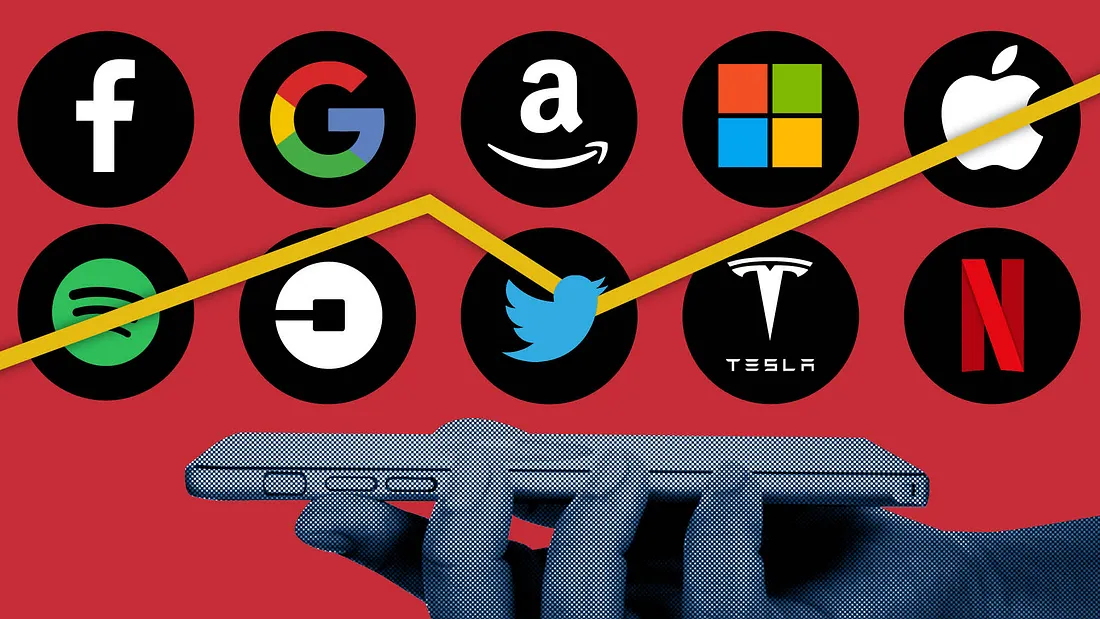
So here's a list of those widely considered to be the top five major players in Big Tech and a little bit about them. Maybe not top five in terms of market cap (though not far away), but in terms of public awareness and likelihood that same public is a direct customer or user that that company's products or services.
____________________
Apple
Founded 1976
Maker of the first widely (at the time) hobbyist microcomputer. Today, Apple is the most profitable maker of laptops, tablets, and smartphones, with a market cap of ~ $4 trillion.
Apple makes their money both by selling their devices and attached services (App Store commissions, iCloud, AppleCare, etc.) That's rare. Most other companies make comparatively little on hardware sales, instead relying more on services and subscriptions. Because of these core strengths, Apple doesn't rely on ad-tech and data brokerage like the other Big Tech players. Let us all hope it stays that way.
Apple singlehandedly kicked-off the smartphone era in 2007 when they introduced the first iPhone. It's difficult to overstate the importance of that event. It was even called the "Jesus Phone" for a while there. They have successfully iterated iPhone over the intervening years and released new groundbreaking products as well. Or, if not entirely groundbreaking, certainly the best examples.
Here are some of Apple's biggest moments.
- Macintosh in 1984 (that famous 1984 Superbowl ad!)
- iPod in 2001, accelerated Apple's turnaround from their late 90's brush with bankruptcy.
- iPhone in 2007, marked the beginning of the smartphone era and turbocharged Apple's growth.
- iPad in 2010. Got off to a slow start but found its niche and has since exploded into a major product category
- Apple smart watch in 2015
- AirPods in 2016
- Apple Silicon M series processors, 2020, a significant improvement making Apple laptops among the most advanced in the world.
For years Apple was widely viewed as a cutting-edge trendsetter, often leading the market while others followed. While they still exhibit some of those qualities today, accumulated experience has shifted their approach toward avoiding high-risk missteps. New initiatives tend to be more carefully studied and show higher refinement at launch. I mean, they certainly have the money to do that.
Still, not everything shines. Apple, as well as everyone else, has had difficulties making 3D vision take hold.
My take: Apple is probably the least offensive of most Big Tech companies. Yeah, I know, what an endorsement.
____________________
Microsoft
Founded 1975
Market cap ~ $3 trillion.
Microsoft's first big success was creating MS-DOS (early personal computer operating system) in a deal with IBM. Critically and presciently, Microsoft licensed MS-DOS to IBM rather than sell it outright. That gave Microsoft the ongoing revenue needed to develop new products, including the upcoming Windows, first released in 1985.
Over the years, Microsoft has released and iterated their Windows OS, making it the #1 desktop OS by a wide margin.
Along the way, Microsoft developed accompanying products to complement and expand Windows dominance, especially in the corporate space. This includes Exchange, Active Directory, Windows Server, Office (Word, Excel, PowerPoint, Outlook, etc.), OneDrive, Azure, and lots of others.
Microsoft's main revenue sources have traditionally been product licensing, services, and now product subscriptions like Office 365. Lately, they are leaning more heavily on the subscription model and they're adding more advertising to the mix to the joy of no one.
A good chunk of Microsoft's revenue comes directly from retail level customers: Home and business.
My take: Microsoft has fully enshittified as far as I can see. So many of their decisions are made to their benefit without regard for their hapless customers. e.g. Windows 11 is an advertising delivery and telemetry platform masquerading as an operating system. Click the accompanying link for more on that, if you'd like. It'll open in a new tab.
____________________
Amazon.com
Founded 1994
Amazon certainly needs no introduction. We all know them as probably the largest online retailer ever. But I'll bet you didn't know some other things about Amazon.
e.g.
- When Amazon first opened they only sold books. This lasted for only a year or two.
- Was originally named "Cadabra", but that was quickly dropped.
- Bezos changed it to Amazon because A is the first letter of the alphabet (thus sorts higher up), it harkens the mighty Amazon River, and just sounded more ambitious.
- Started in Bezos' garage
Obviously a lot has changed since then.
Today, Amazon has a market cap of almost ~ $3 trillion. They sell virtually everything under the sun. Their logistics are insanely efficient and serves as a model for other online retailers, product fulfillment, and shipping in general.
Because Amazon has such a widespread and efficient logistics network, they have enabled products and entire product categories to come into existence that probably never would have otherwise. In other words, if not for Amazon, some of the things we buy on Amazon today, and nowhere else, might not exist. These would be small and/or niche products that could never succeed in a brick and mortar store or with smaller online outlets. Amazon's vast scale is what enables this.
Another advantage to Amazon's efficient logistics network is reduced road miles. Amazon delivery fleet routes are highly optimized by software in order to select efficient routing, speed, and number of miles driven. e.g. Drivers follow a strict route, they don't just deliver in whatever order they want. In this case, more savings for Amazon during delivery often results in a lower carbon footprint.
I mean, it just makes sense, right? Having a delivery truck stop at 200 homes and businesses (pretty typical) is driving a lot less overall than if those same 200 customers each drove to their respective retail stores, clogging up the roads more, to buy what they needed. But for delivery efficiencies to work, like what Amazon does, the deliveries must be one-to-many. A high delivery-density brings down the resources-per-item to a significantly lower level.
That's not true for just any deliveries -- it breaks down badly when using one-to-one or one-to-few gig job delivery systems like Uber Eats, Door Dash, and the others.
Another bit you probably didn't know: Amazon Web Services (AWS) is one of the major virtual hosting providers on the internet. They offer website hosting and other cloud infrastructure for millions of companies and provide industrial scale online services. e.g. If you somehow just unplugged AWS, a good chunk of internet-residing organizations would go offline.
My take:
Jeff Bezos, like most tech bro billionaires, leaves much to be desired and Amazon itself certainly isn't without significant complaint. But I'd proffer that the experience for the majority of their customers is a good one -- unlike, say, with Microsoft.
I like to buy local and will do so when I can. But honestly, most of the arcane parts I buy on Amazon cannot be had locally for any price. It's not like I'm using Amazon because I'm too lazy to drive to Staples, Best Buy, or Ace Hardware. It's because Amazon is often the only choice for the thing I need.
____________________
Alphabet / Google
Founded 1998
Market cap ~ $2 trillion
Google is such a household word that its very name became a verb. Let me Google that for you. It's the most popular search engine by a wide margin. Well, things are changing today with AI-based search, but that's for another article.
Google's secret sauce that magically made their search results more relevant was their groundbreaking PageRank algorithm. It was also insanely fast. Google something and you'd have pages of results often in just one second. Part of what made this possible was the highly distributed nature of Google's architecture. You were never very far away from Google's servers in terms of internet routing hops. (A hop is like an intersection that connects two or more roads)
Then in 2004 Google launched Gmail with 1 GB of storage which was enormous at the time. Gmail marked the transition to a much cleaner, more modern email interface. Spam was, and still is, a big problem. But unlike other email services, Google took the spam problem seriously, developing next level spam filtering for Gmail. As a result of this sweet mix of features, Gmail popularity exploded and it soon became one of the most popular email services -- if not the most popular.
Google is famous for introducing new products and services but they are very impatient. They don't give new products much of a runway to find their audience. If that new thing doesn't take off quickly then it'll roll off the end of the runway and crash into a ravine, so to speak. There's even a website, Killed by Google, chronicling the hundreds of products and services that Google killed off over the years.
Today, Google is mostly an ad-tech company that also runs an email service. Google makes their money from advertising revenue, not so much from user subscriptions.
But don't be concerned about the future of Gmail. That's one of Google's biggest products. Even though it's free for you, it's still strategically important to Google. It's not going away.
What is Alphabet?
That's Google's parent holding company. Alphabet was created in 2015 as a way to separate Google's wildly different businesses. Other companies under Alphabet include Waymo (the self-driving car project) and a few others you've probably never heard of.
My take: Gmail, and its business-oriented sibling, Google Workspace, are good, reliable products. I use and recommend them. Google as a whole isn't so wonderful, but the same can be said about all of Big Tech. I savor the good parts and spit out the bad. That's all any of us can do.
____________________
Meta / Facebook
Founded 2004
Market cap ~ $1.3 trillion
Again, needs no introduction.
In the year prior to Facebook's launch, Mark Zuckerberg built Facemash, a short-lived site that compared Harvard student photos in a “hot or not” style. Facebook itself, launching shortly after, was a separate project focused on social networking and identity-based connections.
While not strictly the first social network to appear, it was the first for the majority of its users. MySpace, a social network that hit its relatively smaller prime in the years before Facebook, had a much smaller, more niche-like following. Facebook busted that open, ushering in widespread use.
A great deal of that uptake success was due to Facebook's real name requirement. By requiring real names and not just made up handles, one could easily find their friends and the whole thing felt more real.
What is Meta?
Meta is not a pure holding company in the way that Alphabet is. It's part rebranding of Facebook and part "parental identity" that Facebook and their other properties exist in. Acquisitions like Instagram, WhatsApp, and Oculus are part of Meta, but not part of Facebook.
Meta's primary revenue source today, 98-plus percent, is ad-tech and everything that entails.
Meta's history is littered with controversy, to wit:
- Cambridge Analytica scandal
- Spreading misinformation in the 2016 US elections
- Antitrust and monopoly concerns. But Meta is hardly alone on this point.
- Not adequately removing harmful content
- Engaging in addictive practices with no regard to mental health, especially to younger users
- Increasing algorithmic feed that boosts revenue (ads, sponsored stories) and declining useful organic content from friends
- Deliberately stoking controversy by what lands in each person's feed
The thru-line in all this is Meta's drive toward increasing ad-tech engagement and thus greater profits.
My take:
Meta is one of the catalysts significantly culpable for the state of today's zeitgeist. Mis- and disinformation, fake news, stoking fear and hate, and political extremism. Meta has provided a worldwide platform with minimal to no practical safeguards for people to spew whatever hate and lies they wish.
Meta may not have deliberately sought to achieve this effect, but achieve it they have. As long as there's money to be made, Meta isn't too interested in bringing down the temperature.
My Pollyanna wish would be for people to stop using Meta products -- and all social networking, for that matter. But that ship and sailed and sank in the Mariana Trench.
____________________
Final Comments
There's other Big Tech titans, such as nVidia, Samsung, AMD, Intel, Oracle, Broadcom, TSMC, Micron, and many others. Each of these, including firms I've not listed here at all, also press major influence on technology, shaping the world we live in, for better and worse.
But the five that I discussed above are the ones that normies like you and me are most likely to have a direct relationship with.